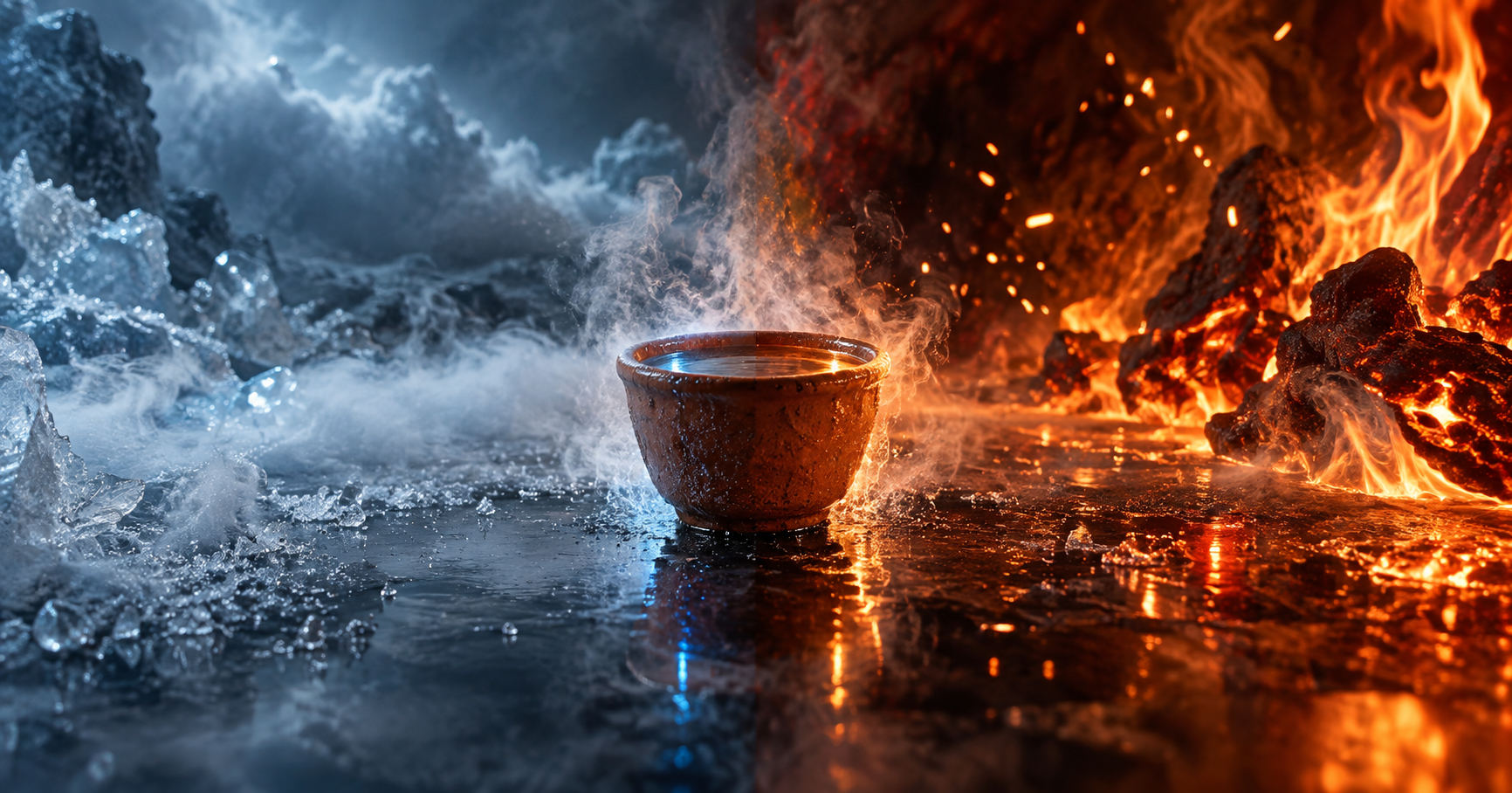
Everyone Asks for Smooth. Nobody Means the Same Thing.
The Model Behind the Pour · Article 5 of 11
Smooth is the most requested word in spirits and one of the least useful, because almost nobody means the same thing by it.
Somebody looks at a shelf full of names they do not recognize, and says give me something smooth.
Smooth is carrying a lot in that sentence. Depending on who is saying it, it usually means one of these things:
- Do not embarrass me, because I do not want to make a face in front of these people.
- Do not hurt me, because the last time I drank something like this it did not end well.
- I do not know anything yet, so start me somewhere safe.
- I want to keep talking, and whatever this is should not interrupt me.
The only thing they share is that none of them is about flavor. Which is why smooth is so hard to serve. Someone asks for it, you pour what you think they meant, and half the time you have answered a different question than the one they asked.
So we started treating it as a position on a line. That line is the second of our two axes, and we call it Calm-Fire.
What the burn actually is
It is not a taste. Your tongue has receptors for sweet, salt, sour, bitter and umami, and burn is not among them. What you are feeling is a pain receptor called TRPV1, the same one that fires when you eat something spicy.
Normally that receptor sits quiet and waits for something genuinely hot. At around 42 degrees Celsius it starts reporting. In 2002 a group led by Marcello Trevisani found that ethanol moves the setting. With alcohol on it, the receptor starts reporting at about 34 degrees instead.1
Your mouth is 37 degrees.
So the burn is not the spirit hurting you. It is your own body temperature crossing a line that has just been moved. A sensor that had nothing to say a moment ago is now telling you that you are too hot, and by the new rules it is correct.
Why does the same bottle drink differently cold? Why is a glass that has been sitting for ten minutes easier than one poured a second ago? None of that is about how much alcohol is in it. It is about a threshold that the alcohol quietly lowered.
Proof and fire are two different dials
I have had mezcal at 55 percent that went down like water, and I have had tequila at 40 that took the top of my head off. If you have spent time with these spirits you have had the same experience, and it feels like it should not be possible.
Stephanie Kokkinidou and Devin Peterson at Ohio State went looking for what actually drives burn in spirits and found that it falls during maturation, and after additional distillation or filtration, while the alcohol content stays exactly where it was.2 Same proof, less fire. A good part of it traced back to carbonyl compounds rather than to the ethanol itself.
Which means burn and strength are two separate dials, and the person at the still sets them separately.
So this axis is not a stand-in for how strong something is. You can read the strength off the label. What the label will not tell you is how the thing is going to arrive, and that was a decision somebody made on purpose, over years, in an oven and a still and a barrel.
When a spirit carries real heat and carries it well, that is not a failure to smooth it out. Somebody wanted it there. And when one lands soft at high proof, that is not weakness. Somebody worked to get it that way. Both are the maestro's signature as much as anything else in the bottle is.
A sip and a shot are not the same tool
Your mouth is not one surface. Danica Berry and Christopher Simons tested capsaicin on four different parts of it and got four different answers. The tongue reports the most irritation, the hard palate next, and the cheek and lip trail well behind.3 So where the liquid goes and how long it stays changes what you feel before anyone has said anything about what is in the glass.
A sip puts a small amount on a surface you are choosing, for a length of time you are choosing. A shot does not choose. It covers everything at once and it is gone before anything has adjusted.
None of that is a criticism of shots. It is a description of a different tool. Most of the flavor reaches you through your nose, on the way back up, after the liquid has been in your mouth a while. Burn does not wait for any of that. So a shot hands you all of the fast part and almost none of the slow part, which is exactly right if what you wanted was to start something with other people at the same moment.
Berry and Simons also tested the same spot twice in a single sitting. One exposure, then a rest until the feeling had gone, then a second. The area that had been touched before came back reading noticeably calmer than the untouched area beside it.
So the first sip of anything is mostly the shock of something arriving at all, and you cannot separate the spirit from the surprise. Prime your mouth first and the second sip gets read against a baseline that is already set. You are not taking the fire away. You are taking the surprise away.
Some nights you want the fire
There are nights when the fire is the entire point. When you want to feel something arrive, when a soft pour would be a letdown. A spirit that interrupts you is not being rude. Sometimes interrupting you is the job.
And there are nights for the opposite. Something that will sit under a long conversation without asking for anything.
The mistake is not choosing one. The mistake is thinking one of them is the better bottle. They are two pieces of craft aimed at two different evenings, and the person who made them knew which one they were making.
What we are actually asking
So when we ask how much fire you want tonight, we are not asking how brave you are and we are not asking what you can handle. We are asking what you want the pour to do when it gets there. Come in quietly and stay a while, or announce itself.
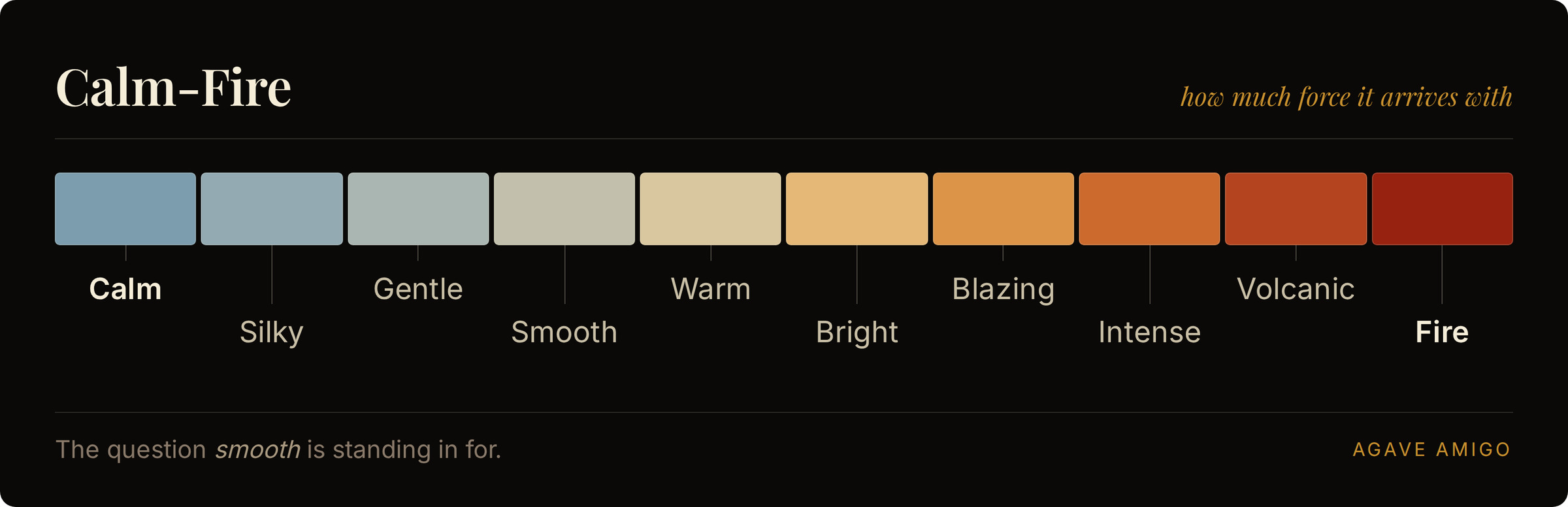
We ask every time instead of remembering your answer, because the answer moves. The same person wants different things in February and in July.
Smooth is not a preference you have. It is a thing you want sometimes.
· · ·
References
- Trevisani, M., et al. (2002). Ethanol elicits and potentiates nociceptor responses via the vanilloid receptor-1. Nature Neuroscience, 5(6), 546–551.
- Kokkinidou, S., & Peterson, D. G. (2016). Identification of compounds that contribute to trigeminal burn in aqueous ethanol solutions. Food Chemistry, 211, 757–762.
- Berry, D. N., & Simons, C. T. (2020). Assessing regional sensitivity and desensitization to capsaicin among oral cavity mucosae. Chemical Senses, 45(6), 457–466.
Choose your Moment and discover Your Pour.
Find Your Pour →A note on language. Proper nouns keep their names in every language: spirits, agave varietals, brands, and the people who make them.