The Emotional Tasting Profile
The Model Behind the Pour · Article 3 of 11
Nobody drinks for the flavor. Thirty years of research has never once said otherwise. Here is what we built instead: two axes, eight colors, six moments, and the arithmetic underneath.
Reason is, and ought only to be the slave of the passions, and can never pretend to any other office than to serve and obey them.
— David Hume, A Treatise of Human Nature, 17391
Hume is not saying feelings matter too. He is saying feeling picks, and reason is staff. The argument you make afterward is not the reason you chose. It is the paperwork.
He had no anatomy to point at. Two hundred and fifty years later, we do.
Smell is special
Every sense you own reports to a relay station first. Sight, sound, touch, taste: all routed through the thalamus, checked and forwarded.
Smell does not.
The olfactory bulb wires straight into the amygdala and the hippocampus, the seats of emotion and memory, with no relay in between.2 It is the only sense with that privilege. A smell is inside the emotional brain before any other part of you has been consulted.
And aroma is most of what you call taste.
So a mezcal is not a flavor arriving. It is a signal holding a key to a door the rest of your senses have to knock on.
Rachel Herz spent years testing what this does to memory. Her result is precise and strange: memories triggered by smell are not more accurate than memories triggered by a photograph. Not more detailed either. They are more emotional, and the amygdala fires harder when the memory comes through the nose.3
Which explains the thing everyone has experienced and nobody can account for. A pour lands, and what comes back is not the drink. It is a kitchen. A grandmother. A particular afternoon in a town you left.
The spirit is not the memory. It is the key.
Nobody drinks for the flavor
In 1994 Lynne Cooper published a four-factor model of why people drink. It has been validated and re-validated across populations for thirty years.4 The four reasons:
- Social. Because that is what the room is doing.
- Enhancement. Because tonight should be more than it currently is.
- Coping. Because something needs quieting.
- Conformity. Because abstaining would be its own announcement.
Read them again. Not one is about flavor.
Thirty years of research into why human beings reach for a bottle, and the answer has never once come back as a tasting note. It comes back as a state you are in and a state you would rather be in.
That gap is what a recommendation should be aiming at. Instead the entire category aims at the label.
A sudden immersion in the formless
I have sat in enough bars, and two things get described over and over, neither of them a flavor.
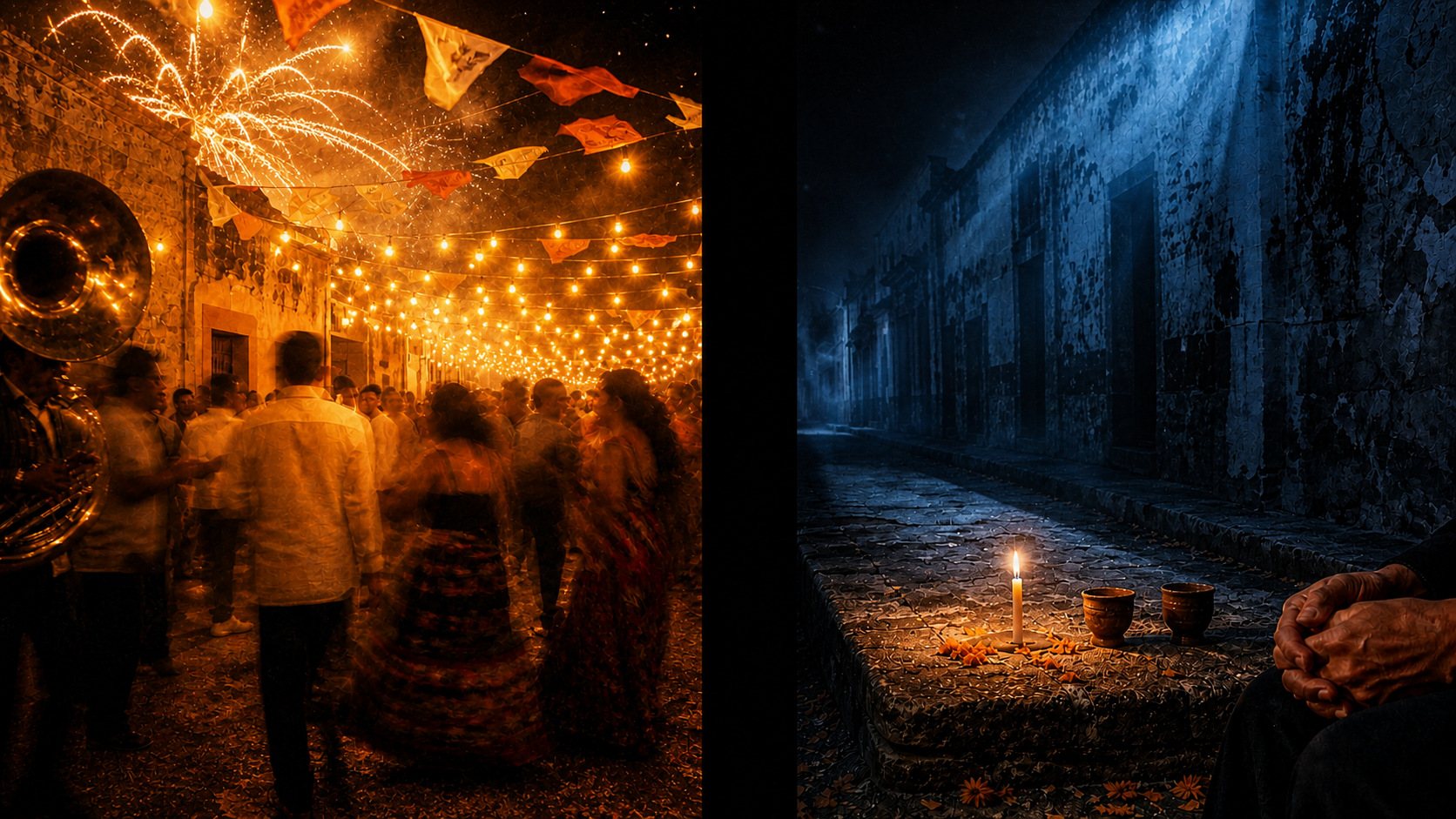
The first is where the pour points. Some nights it pushes outward; the bottle belongs to the room, everyone is louder, nobody is examining anything. Other nights the same liquid pulls inward. The room goes quiet. Someone pours a small measure and does not drink it immediately, and the gesture turns ceremonial without anyone announcing it.
Octavio Paz wrote the definitive account of both ends of that line seventy-six years ago, and he was not writing about spirits:
the fiesta is not only an excess, a ritual squandering of the goods painfully accumulated during the rest of the year; it is also a revolt, a sudden immersion in the formless, in pure being.
— Octavio Paz, The Labyrinth of Solitude, 19505
Earlier in the same chapter, the shortest true sentence anyone has written about Mexico: we are a ritual people.6
Excess at one end. Ritual at the other. In Mexico that is not poetry; mezcal and tequila are poured at funerals, at weddings, and when a house is finished, and nobody confuses those pours with a Friday.
One line, ten steps. We call it Party-Magic:
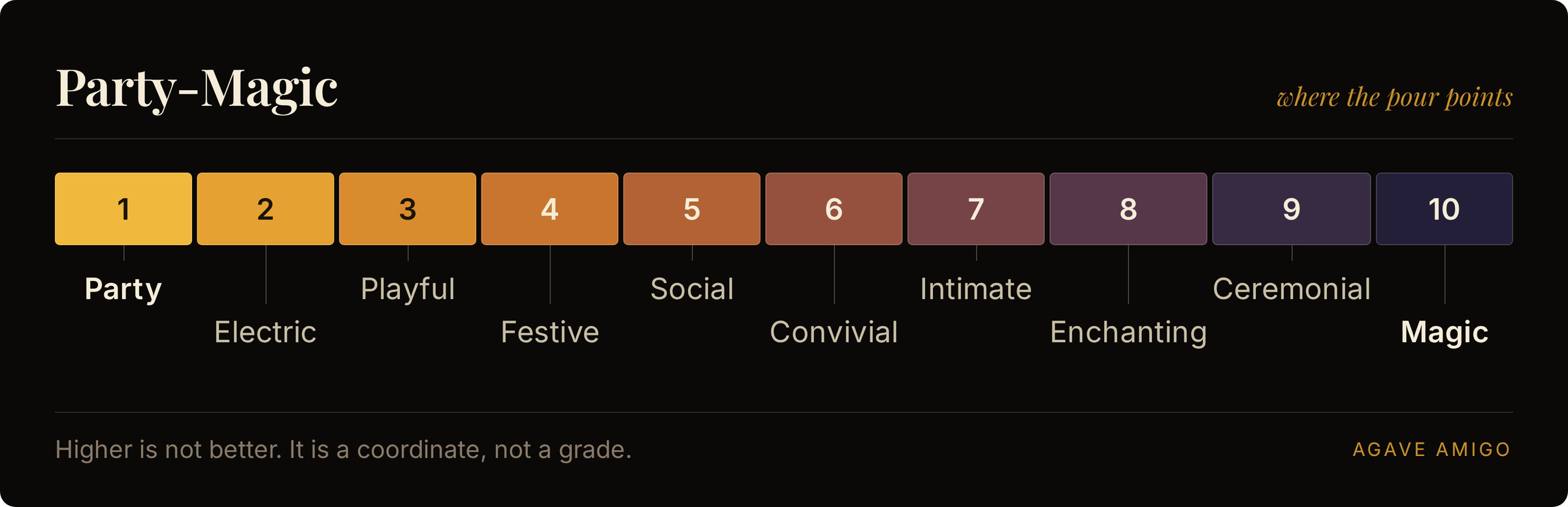
Higher is not better. A ten is not more refined than a one. It is a coordinate, not a grade.
The second thing people describe is force. Some spirits are companionable: smooth, undemanding, happy to sit under a conversation for an hour. Others make a statement on contact: a kick, a burn, a deliberate arrival. They interrupt.
Ten more steps. Calm-Fire:
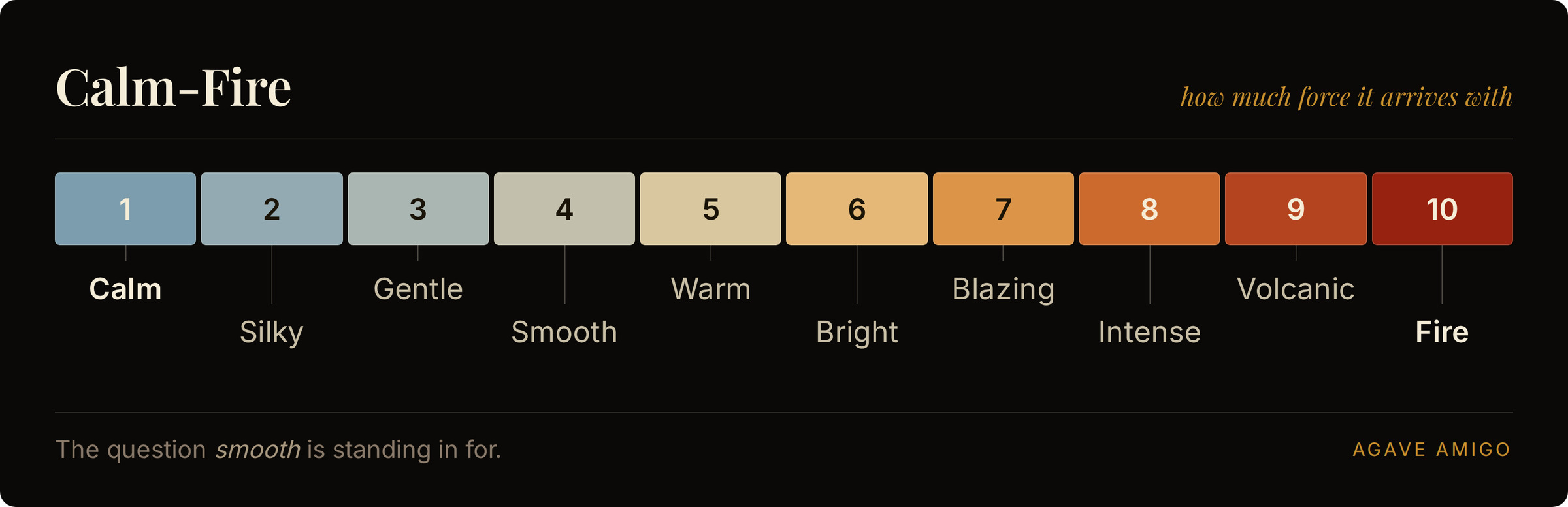
This axis exists because smooth is the most requested and least useful word in spirits. It stands in for the real question nobody asks out loud: how much fire do you want tonight, and are you moving toward it or away from it?
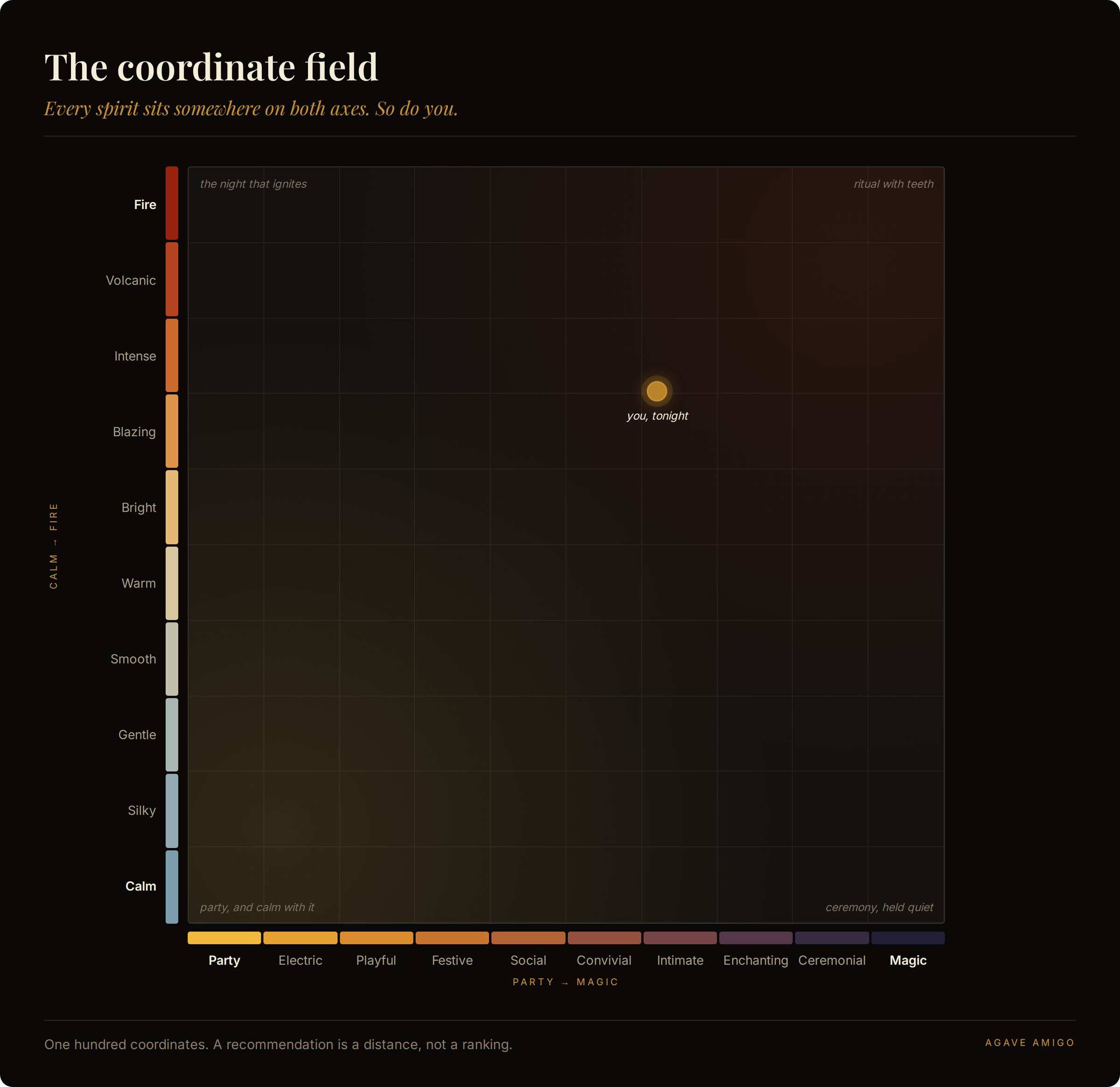
Two axes. Every spirit in the catalog sits somewhere on both. So do you.
You finish the circuit
A spirit's position is half a match. You are the other half, and you move.
A color. Eight of them, one feeling each: Desert Rose is Tender, Obsidian Black is Ritual, Mineral Earth is Grounded, Amber Gold is Celebratory, Copper Flame is Fierce, Sage Green is Fresh, Cream Ivory is Naked, Ocean Blue is Still. We ask for a color because nobody has to justify one. It arrives before the sentence does, which matters, because what people say about a feeling is a poor proxy for the feeling.7
A moment. Six of them: Just Me, Good Company, Let's Go, Surprise Me, New to This, Intentional. Not a room, not a mood. One thing containing both, which is why we never ask a second question about your state of mind.
The arithmetic
Four weighted policies, and the two axes are averaged into one emotional score before anything else happens.
- Emotional match
- Moment fit
- Color fit
- Rating
They do not carry equal weight. Emotional match leads, and by a wide margin. That is Hume's sentence, written as a number.
Before scoring, factual filters run: smoked, aged, infused. They never raise a score; they only let you rule a trait in or out. After scoring, an expert's endorsement or a friend's can lift a spirit into view, bounded and deliberately outside the hundred percent.
Same inputs, same five spirits, every time. No randomness anywhere in it. That is the difference between a recommendation and a shuffle.
What we do not claim
The research above is real and it belongs to other people. What we built on top of it is a model, not a science. The day there is a validation study, the word changes.
Our Moment targets are considered estimates, not measured coefficients. Character is declared in our catalog, not read off a photograph of a label. There is no compatibility score between two people; it is a direction, not a feature.
We would rather publish the model now and be corrected by evidence than call it settled before it has earned that.
The only review that lasts
People will forget what you said, people will forget what you did, but people will never forget how you made them feel.
— Maya Angelou8
Nobody has ever remembered a tasting note. Everybody remembers the night.
Your body already knows which one it wants. We are just asking it out loud.
· · ·
References
- Hume, D. (1739). A Treatise of Human Nature, Book II, Part III, §III.
- Zhou, G., et al. (2025). The human olfactory amygdala: anatomical connections between the olfactory bulb and amygdala subregions. Imaging Neuroscience, MIT Press.
- Herz, R. S., Eliassen, J., Beland, S., & Souza, T. (2004). Neuroimaging evidence for the emotional potency of odor-evoked memory. Neuropsychologia, 42(3), 371–378. See also Herz & Schooler (2002), American Journal of Psychology, 115(1), 21–32.
- Cooper, M. L. (1994). Motivations for alcohol use among adolescents: development and validation of a four-factor model. Psychological Assessment, 6(2), 117–128.
- Paz, O. (1950). El laberinto de la soledad, chapter III, “Todos Santos, Día de Muertos.” English from The Labyrinth of Solitude, trans. Lysander Kemp. Original: “Así pues, la Fiesta no es solamente un exceso, un desperdicio ritual de los bienes penosamente acumulados durante todo el año; también es una revuelta, una súbita inmersión en lo informe, en la vida pura.”
- Paz, ibid. Original: “Somos un pueblo ritual.”
- Deng, Y., Chang, L., Yang, M., Huo, M., & Zhou, R. (2016). Gender differences in emotional response: inconsistency between experience and expressivity. PLOS ONE, 11(6), e0158666.
- Angelou, M. Spoken by Angelou on many occasions and long associated with her. The underlying sentiment has been traced by Quote Investigator to Carl W. Buehner (1971); Angelou is the reason anyone remembers it.
Choose your Moment and discover Your Pour.
Find Your Pour →A note on language. Proper nouns keep their names in every language: spirits, agave varietals, brands, and the people who make them.