Trust & Transparency · Article 6 of 11
Nothing Hidden
Almost nothing in your glass was invented here. It was brought, borrowed, adapted and made ours, which is how everything good gets made. The problem was never what anyone added. The problem is that the bottle is not allowed to tell you.
The most Mexican taco in Mexico is Lebanese
The trompo turning by the door of every taquería came from Lebanon. Immigrant families brought shawarma to Puebla, somebody swapped the lamb for pork, somebody else added achiote and put a pineapple on top, and the result is al pastor. Nobody in Mexico has ever once asked whether al pastor is Mexican.
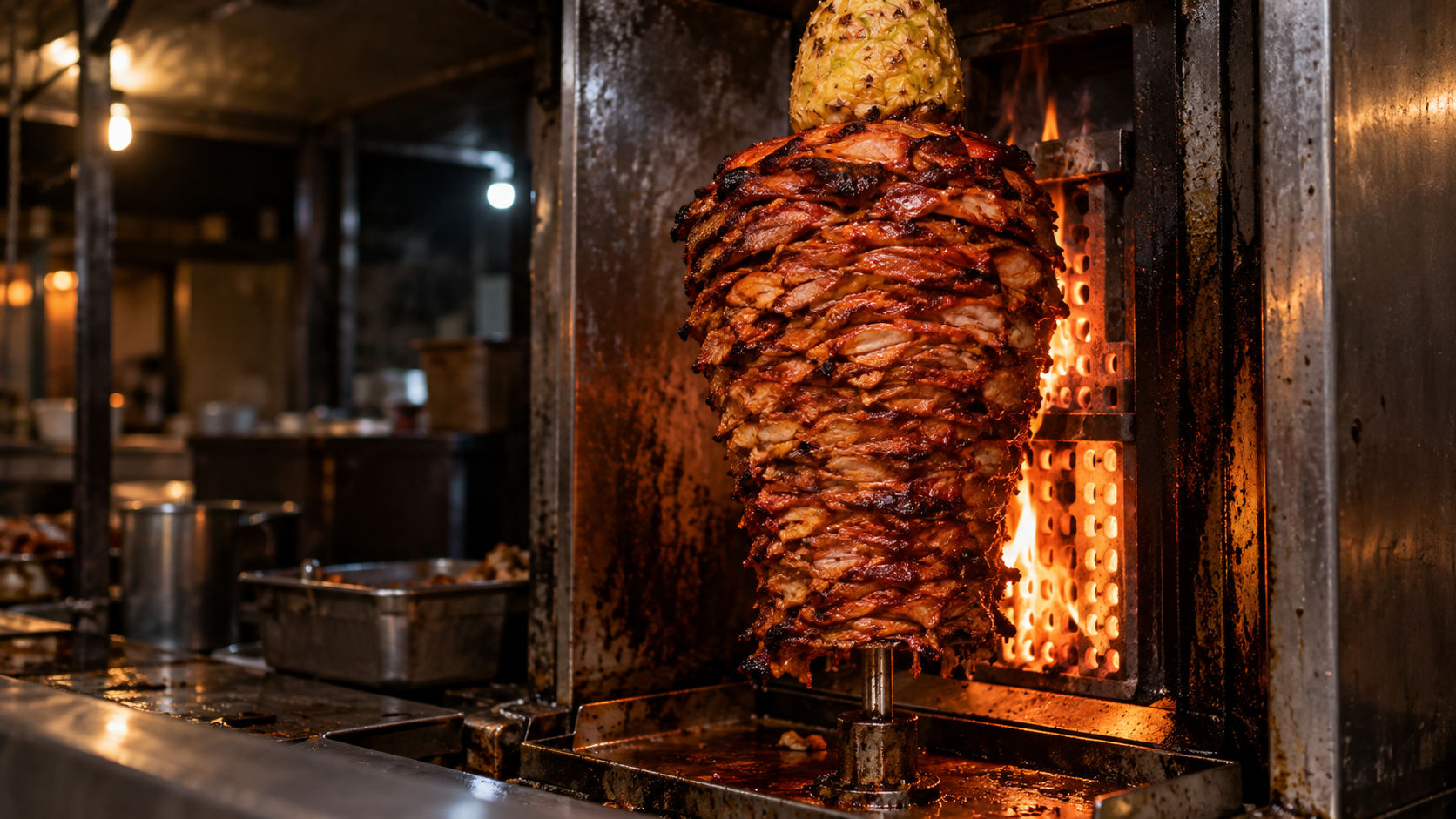
That is what a tradition actually is. Somebody's borrowed idea that stayed long enough to become the family recipe. Nothing pure ever tasted like anything.
So who taught Mexico to distill?
One story says the Spanish brought it around 1600, conquistadors running out of brandy. Or 1564, when the first galleon sailed and Filipino crews settled in Colima and started making spirit out of coconut wine. By 1610 that one village had sixty bars selling it. Sixty. In a village. Or long before either ship, and archaeologists will point you at maguey ovens at Xochitécatl fired somewhere between 878 and 487 BCE.
Nobody has won, and I hope nobody does. A category still arguing about where it came from has no bloodline to defend, and that turns out to be a gift.
The barrel came from a congressman in Arkansas
In 1938 the United States made it illegal to age bourbon in a used barrel. Not for flavor. It was a jobs bill for the people who make barrels. Ever since, America has produced a steady tide of perfectly good oak that can never again do the job it was built for, and a great deal of it drifted south looking for work.
Blanco and añejo first appear in the Mexican standard in 1964. Reposado does not get a definition until 1968. Extra añejo did not exist until 2006, which makes it younger than Google.
1964 is also the year the agave minimum fell from one hundred percent to seventy. 1968, the year reposado was born, is the year flavorings and colorings were let in. By 1970 the minimum was fifty one percent.
Añejo and caramel coloring are the same age. Written by the same people, four years apart, in the same push to sell more abroad. We inherited both and decided to love one of them.
That is not a scandal. That is just how anything gets built. Every tradition is somebody's shortcut that got old enough to be respectable.
Gin does what a pechuga does
Gin is a spirit redistilled with botanicals. First written mention of juniper spirit: 1551. By 1595 a man in Leiden was selling juniper-flavored malt wine and doing rather well out of it.
A pechuga is a third distillation with fruit, nuts and a turkey breast hanging inside the still. First time anybody wrote it down: 1863, when Manuel Payno described a wine rectified by adding chicken and called it vino de pechuga.
The same idea, three hundred years apart on paper. And the gap is in the paper, not the practice. Gin was made by literate guilds a short walk from a printing press. Pechuga was made in mountains where nobody was writing anything down about anything.
Nobody has ever called gin adulterated. One of them just had better stationery.
Everyone does this, and most of them have a number for it
Bourbon: no harmless coloring, flavoring or blending materials under the United States standard.
Scotch: plain caramel E150a is permitted. In the European Union, an ingredient list is not required on the label.
Blended American whiskey: permitted coloring, flavoring and blending materials may total up to two and a half percent of the finished volume under United States rules. They are not itemized as ingredients on the label.
Canadian whisky: flavouring spirits or wine may account for up to 9.090 percent of the finished whisky's total absolute alcohol. In Canada, the ingredient list is exempt. There is a whole faction in that industry arguing the rule is a feature worth celebrating.
Cognac: plain caramel E150a, sweetening and oak-chip infusion are permitted under its French specification. In the European Union, an ingredient list is not required. At four figures a bottle.
Champagne: dosage in more than ninety percent of wines, and the sugar category is compulsory on the label in the European Union. Brut nature, extra brut, brut, sec, demi-sec. Nobody has ever thought less of Champagne. The telling became the vocabulary instead of the shame.
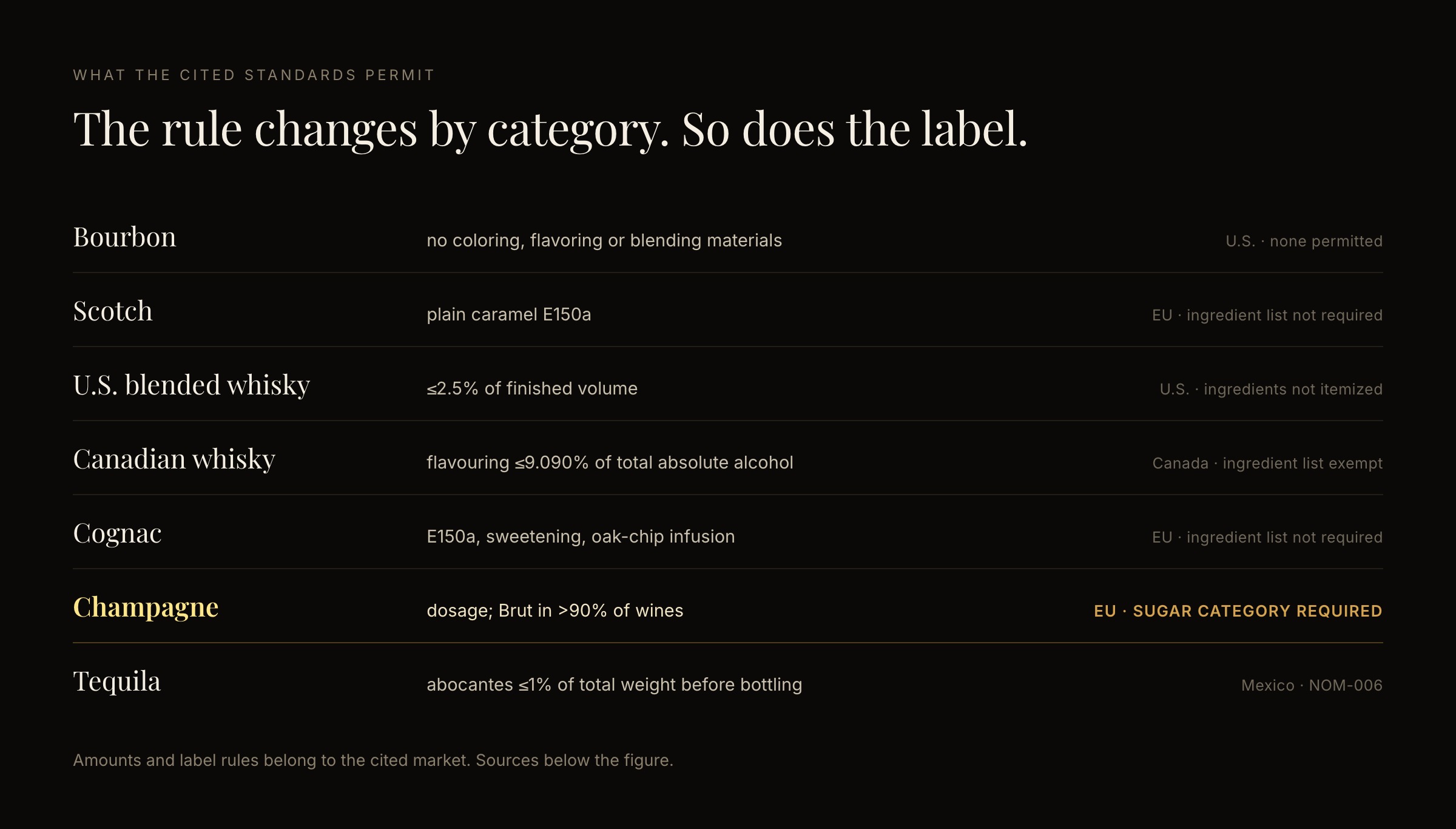
Sources: Bourbon and U.S. blended whisky; Scotch; EU labels; Canadian whisky and Canadian labels; Cognac; Champagne dosage and labels; Tequila.
Our industry already has a word for it
The word is abocante. The clearest definition of it I have found is published by Patrón. On their own website. Under Education.
Patrón describes abocantes as mellowing agents, legal additives used to imitate the effect of aging. Under NOM-006, Tequila may contain sugar syrup, glycerin, oak extract or caramel color up to one percent of its total weight before bottling.
These are rarely talked about in the industry. In Mexico, NOM-006 does not require the label to itemize them.
A major producer, explaining the practice accurately, in public, on a page meant to teach people. Nobody had to leak anything. It has been sitting in the open the whole time.
Steve Ury, who knows brandy far better than I do, told VinePair it is not as if brands using boisé are scam artists. Matt Pietrek, on why any of this happens at all: not in any attempt to deceive people, it is more like, this tastes good and people like it.
Legal. Ordinary. Older than all of us. And quiet.
The problem was never the technique
It is that the bottle is not allowed to talk.
VinePair reports that the CRT's position is that tequila brands may not discuss the use or non-use of legal additives on packaging or in marketing. That is the regulator's position, not a universal statement of what is lawful in every market: Patrón argues that the CRT has no authority over its advertising in the United States.
Under that position, a house that adds nothing cannot say so. A house that adds something cannot say that either. The required position is silence, and silence looks exactly the same from both sides.
A maestro knows every decision in the bottle and is proud of all of them, and has not one legal square inch of glass to write them on. That is not somebody hiding. That is somebody with nowhere to speak.
None of this is new. In the early 1600s the Spanish crown banned vino de cocos, announcing it was a wine of the land that caused harms. In its own ledgers the crown wrote the actual reason: Castilian wine sales were suffering and the treasury was losing tax money. The ban came off in 1626, after a hurricane flattened the cacao crop and the economy suddenly needed the spirit back. Later Guadalajara skipped the moralizing altogether, took the distribution monopoly and priced it out of reach. Four hundred years, and not one of these rules was written by the person drinking.
Amy Pasquet, who makes Cognac, said it out loud in that same piece. Instead of saying we do not add anything, she said, we say everything is natural. That is a woman choosing her words carefully because she is not allowed better ones. She would love to see more transparency in Cognac. She just has nowhere to put it.
So we built somewhere to put it
A brand writes down what went in, how it was made and where it came from. One bottle at a time, not one statement stretched over the whole house, because a house can account for one expression completely and buy another in bulk, and a single mark across the company would quietly launder the second behind the first.
We publish what they wrote, in their words. We do not test it and we do not certify it, and the page says so right beside the declaration. Brand declaration, not tested or certified by Agave Amigo.
A certifier hands down a verdict. We just write it down and sign whose it is. We are not standing behind the claim. We are standing behind the fact that a brand made it.
Nada Oculto appears when a declaration says three things. Every fermentable sugar came from the plant named on the bottle, and heat made it, not acid. Nothing was added whose purpose is to make this spirit resemble one it is not. And a person put their name to it.
That much is a judgment, and I would rather describe it than pretend otherwise.
A pechuga keeps it. An abocado con gusano keeps it. They add flavor, not fermentable sugar, so the first condition already covers them. We never had to write them an exception, which is how I know the rule is the right shape. Nobody hangs a turkey in a still hoping you will not notice.
Cooking is in there because of what the word means. Mezcal comes from mexcalli, from metl, agave, and ixcalli, cooked. The word means cooked agave. Tequila comes out of that lineage, even though the two are separate denominations today. Strip the sugar out of a raw plant with acid and the thing the word describes did not happen.
A diffuser used after cooking changes nothing here. It is an extraction step, the way a mill is. What fails is not the machine. It is that the agave was never cooked.
And there is a real argument on the other side, which I will not pretend away. Casa Sauza publishes their own account of the diffuser and claims extraction above ninety five percent and fewer kilos of agave per liter. In a category that keeps running out of a plant that takes years to grow, that is not nothing. Somebody could build an honest mark around yield instead of around cooking and they would not be wrong. Ours is around cooking. That is a choice, and we are telling you it is one.
None of it is a verdict on the bottles without it. A declaration publishes either way. A house that tells us about the glycerin gets their words on their page, in their language. They do not get the mark. They do not get anything else either. No flag, no list, no comparison.
And a bottle with no declaration is not a suspect bottle. It is a bottle whose maker has not filled in a form. Some of them have never heard of us. That is our problem, not theirs.
If you are proud of how you make it
Twenty five years ago nobody cared about caramel in Scotch. Ury said that too, and he is right that these things move. They are moving now.
So here is the offer, and it is a small one. We are not asking anyone to be pure. Purity was never on the table and it never built anything good. We are asking whether you would like somewhere to say what you actually do. The oven or the autoclave. The tahona or the mill. The yeast, the still, the number of passes, the species, the years it took to grow, the name of the person who made it.
Everything in this category was borrowed from somewhere, improved by somebody, and is still being argued about. That is not a confession. That is the craft.
If you are proud of your art, this is a place to describe it.
· · ·
References
- Goguitchaichvili, A., et al. (2018). Archaeomagnetic evidence of pre-Hispanic origin of Mezcal. Journal of Archaeological Science: Reports, 21, 504–511.
- Zizumbo-Villarreal, D., et al. Early coconut distillation and the origins of mezcal and tequila spirits in west-central Mexico. Genetic Resources and Crop Evolution.
- Machuca, P. (2018). El vino de cocos en la Nueva España. El Colegio de Michoacán.
- Payno, M. (1863). Memoria sobre el maguey mexicano y sus diversos productos. Boletín de la Sociedad Mexicana de Geografía y Estadística.
- Academia Patrón. Abocantes; Standardization of the Tequila Category. academiapatron.com
- What Additives are Permitted in Whisky. Whisky Advocate.
- Skiver Barton, S. (20 May 2025). Tequila Isn't the Only Spirit to Use Additives. Why Aren't We Talking About the Others? VinePair.
- Kell, J. (13 May 2025). After Clash In Mexico, Patrón Defends Additive-Free Tequila Messaging. Forbes.
- Casa Sauza. What Is a Diffuser and How Does It Work. casasauza.com
Choose your Moment and discover Your Pour.
Find Your Pour →A note on language. Proper nouns keep their names in every language: spirits, agave varietals, brands, and the people who make them.